
Five Emerging Risks Facing Critical Infrastructure—and Why They Matter to Business
Critical infrastructure risks are often discussed in terms of national security, but they also have immediate consequences for companies’ operations, supply chains, and financial performance. When essential systems fail or are disrupted, the impacts ripple across industries—halting production, interrupting logistics, increasing costs, and undermining customer trust.
As infrastructure systems become more interconnected and technologically complex, several emerging risks are reshaping the operating environment for companies across sectors.
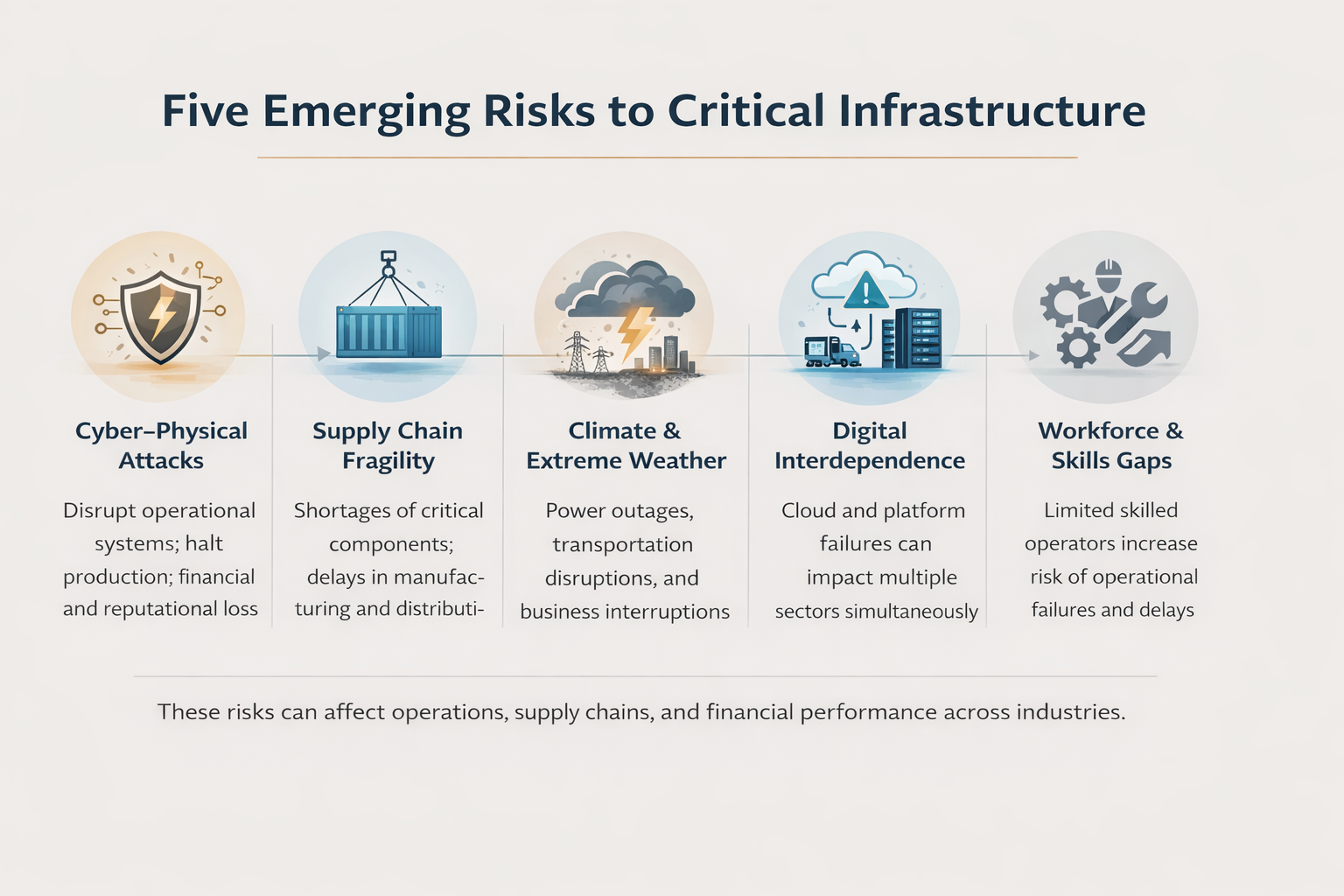
1. Cyber–Physical Attacks on Operational Systems
Cyberattacks increasingly target operational technology (OT)—the industrial systems that control pipelines, power plants, manufacturing facilities, and transportation networks. Unlike traditional IT breaches, disruptions to OT systems can halt physical operations.
The 2021 ransomware attack on the Colonial Pipeline Company temporarily shut down the largest fuel pipeline in the United States, leading to regional fuel shortages and billions of dollars in economic disruption. For businesses dependent on fuel logistics—from airlines to trucking firms—the ripple effects were immediate.
For companies, cyber resilience is no longer just an IT issue—it is an operational continuity and financial risk issue.
2. Supply Chain Concentration and Fragility
Many infrastructure sectors depend on globally concentrated suppliers for critical components such as semiconductors, transformers, industrial chemicals, and specialized software.
Recent supply chain disruptions—from pandemic-era manufacturing shutdowns to geopolitical tensions—have demonstrated how quickly shortages can disrupt operations and drive up costs. Infrastructure operators and the companies that depend on them often have limited alternatives when key components or services become unavailable.
For businesses, supply chain fragility can translate directly into production delays, lost revenue, and increased procurement costs.
3. Climate and Extreme Weather
Extreme weather events are placing increasing stress on infrastructure systems such as power grids, transportation networks, and water systems. Hurricanes, wildfires, floods, and heatwaves can disrupt operations for weeks or months, affecting both infrastructure providers and the businesses that rely on them.
When power outages halt manufacturing, or transportation disruptions delay deliveries, companies face not only operational setbacks but also contractual penalties, reputational damage, and lost market share.
As climate risks grow, infrastructure resilience is becoming a core business continuity concern for companies across sectors.
4. Growing Digital Interdependence
Modern infrastructure sectors depend heavily on shared digital platforms, cloud services, and interconnected networks. While this connectivity enables efficiency and innovation, it also means that disruptions in one digital service can cascade across industries.
The global software supply chain compromise affecting SolarWinds illustrated how vulnerabilities in widely used technology platforms can expose thousands of organizations simultaneously.
For companies, digital interdependence means that third-party risk and infrastructure resilience are inseparable from enterprise risk management.
5. Workforce and Skills Gaps
Many infrastructure sectors face a growing shortage of skilled workers in areas such as cybersecurity, engineering, industrial operations, and grid management. As experienced workers retire, organizations often struggle to replace decades of institutional knowledge.
Workforce shortages can slow maintenance, delay upgrades, and increase the risk of operational errors—creating vulnerabilities that affect infrastructure reliability.
For companies, these workforce challenges can translate into higher operating costs, slower innovation, and increased operational risk.
Why Cross-Sector Collaboration Matters
Because infrastructure sectors are deeply interconnected, companies cannot manage these risks alone. Disruptions often originate outside an organization’s direct control—within suppliers, partner sectors, or shared digital systems.
Addressing emerging infrastructure risks requires collaboration across industry, government, and research communities to share information, identify systemic vulnerabilities, and develop coordinated solutions.
The Center for Cross-Sector Coordination (CXC) exists to support that collaboration—bringing together leaders across sectors to better understand emerging risks and strengthen the resilience of the systems that businesses and communities depend on every day.
Sources
Cybersecurity and Infrastructure Security Agency. Critical Infrastructure Security and Resilience Resources.
World Economic Forum. Global Risks Report.
National Institute of Standards and Technology. Cybersecurity Framework and Infrastructure Guidance.
U.S. Department of Homeland Security. National Infrastructure Protection Plan (NIPP).
Congressional Research Service. Critical Infrastructure: Emerging Trends and Policy Considerations.
What is Critical Infrastructure?
Critical infrastructure refers to the essential systems and services that keep society functioning. In the United States, the term includes the assets, systems, and networks—both physical and digital—“so vital to the United States that their incapacitation or destruction would have a debilitating impact on security, national economic security, national public health or safety” (U.S. Cybersecurity and Infrastructure Security Agency, 2021).
Critical infrastructure refers to the essential systems and services that keep society functioning. In the United States, the term includes the assets, systems, and networks—both physical and digital—“so vital to the United States that their incapacitation or destruction would have a debilitating impact on security, national economic security, national public health or safety” (U.S. Cybersecurity and Infrastructure Security Agency, 2021).
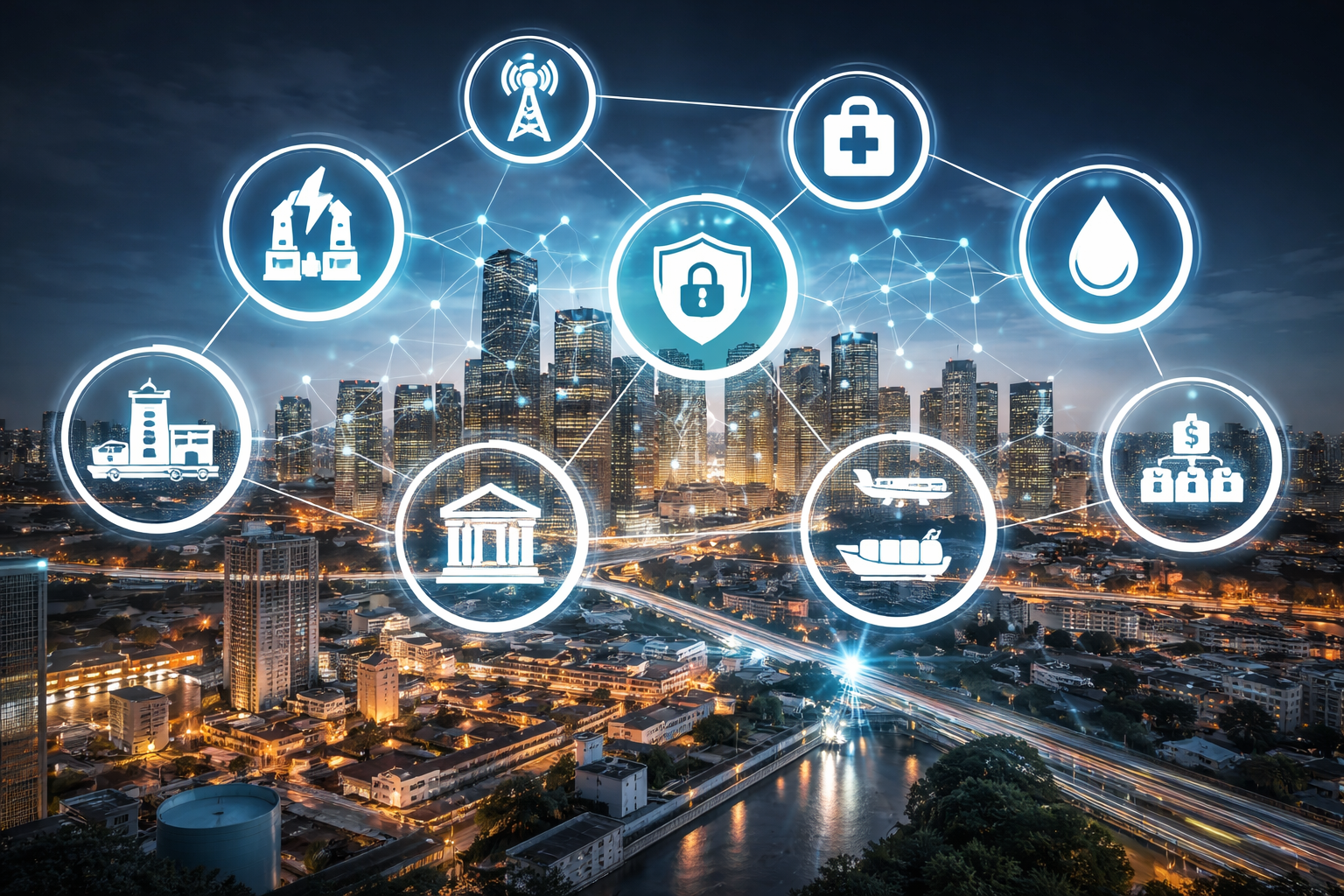
These systems underpin daily life: they deliver electricity and water, enable communications, move goods and people, support financial transactions, provide medical care, and supply food to communities. Because modern infrastructure systems are deeply interconnected, disruptions in one sector can cascade across others—affecting communities, businesses, and national security.
To organize national security and resilience efforts, the U.S. government recognizes 16 critical infrastructure sectors, including energy, communications, transportation systems, healthcare and public health, financial services, water and wastewater, and food and agriculture, among others.
Unlike many national security domains, most critical infrastructure in the United States is owned and operated by the private sector, requiring strong partnerships between industry, government, and the research community to manage risks and ensure resilience.
The Center for Cross-Sector Coordination (CXC) exists to strengthen those partnerships—helping leaders across sectors share information, align strategies, and collaborate on solutions that protect the systems society depends on every day.
Why Critical Infrastructure Is Increasingly Vulnerable
The systems that power modern life are more connected—and more complex—than ever before. Digital technologies, global supply chains, and automation have created enormous efficiencies, but they have also increased the potential for disruption.
Critical infrastructure operators today face a wide range of risks, including cyberattacks, extreme weather, aging infrastructure, geopolitical instability, and supply chain disruptions. Because infrastructure sectors depend heavily on one another, a disruption in one system can quickly cascade into others. For example, energy disruptions can affect communications and healthcare systems, while transportation disruptions can interrupt food and medical supply chains.
The growing interdependence between sectors means that resilience can no longer be addressed in isolation. Protecting critical infrastructure requires coordinated planning, information sharing, and risk management across sectors and organizations.
Why Cross-Sector Coordination Matters
In the United States, the vast majority of critical infrastructure is owned and operated by private companies, while government agencies play key roles in regulation, security, and emergency response. Universities, research institutions, industry associations, and nonprofit organizations also contribute expertise, innovation, and workforce development.
No single organization has full visibility into the risks facing critical infrastructure systems. Effective resilience therefore depends on collaboration across sectors—bringing together leaders to share insights, identify emerging risks, and coordinate solutions.
The Center for Cross-Sector Coordination (CXC) helps make this collaboration possible. By creating trusted forums for dialogue and partnership, CXC connects leaders across sectors to strengthen resilience, improve risk awareness, and protect the infrastructure systems that communities and economies depend on every day.
Learn More:
Cybersecurity and Infrastructure Security Agency (CISA). Critical Infrastructure Security and Resilience and Critical Infrastructure Sectors.
National Institute of Standards and Technology (NIST). Glossary: Critical Infrastructure.
USA PATRIOT Act, 42 U.S.C. §5195c (definition of critical infrastructure).
Congressional Research Service. Overview of U.S. Critical Infrastructure Sectors.
U.S. Department of Homeland Security. National Infrastructure Protection Plan (NIPP).